In today’s fast-paced business environment, creative directors and marketing leaders are under pressure to save time while increasing ROI. AI is often positioned as the solution, and while it does offer meaningful advantages, its real value is frequently misunderstood. AI is not a strategy on its own. It is a powerful tool within a broader marketing system.
When used correctly, AI helps automate tasks, accelerate analysis, and support decision-making. This frees teams to spend more time on creative strategy and less on manual execution. However, the greatest gains in efficiency and ROI are not achieved by AI in isolation. They come from automation frameworks that are augmented by AI and designed to scale intelligently.
Consider a marketing team using AI-driven analytics to evaluate campaign performance in real time. On the surface, this appears to be an AI success story. In reality, the ROI is unlocked when those insights feed directly into automated workflows. Campaign rules, templates, and distribution systems adjust messaging, creative, or spend automatically based on performance signals. The outcome is not just faster insight, but faster action at scale.
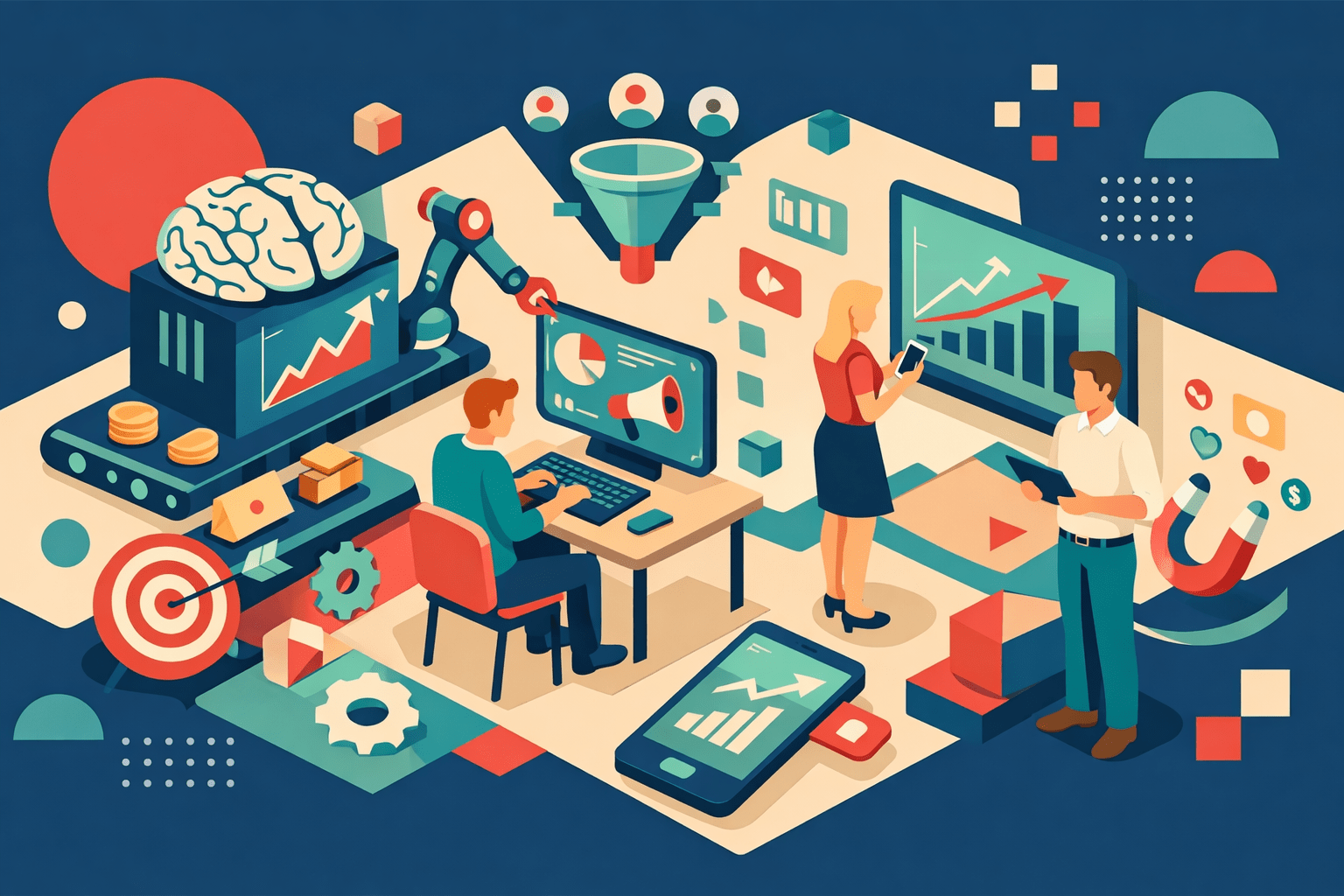
AI excels at pattern recognition, prediction, and content generation. Automation excels at orchestration. When combined, they create dynamic marketing systems that outperform static campaigns.
Automation systems can connect templates, structured data sets, APIs, and decision logic into a repeatable framework. AI can then assist within that framework by generating variations, summarizing insights, or personalizing elements. Without automation, AI outputs remain one-off artifacts that still require manual coordination. With automation, those outputs become inputs into a scalable system.
For example, an e-commerce brand may use AI to analyze browsing and purchase behavior. The real ROI appears when that analysis automatically triggers personalized product recommendations, updates creative layouts, and deploys tailored messaging across channels without manual intervention. This shift transforms marketing from a series of tasks into a continuously adapting engine.
When AI is implemented inside an automation-first strategy, several benefits emerge more clearly.
Operational efficiency improves because repetitive tasks are not just automated once, but systematized. Templates, workflows, and rulesets reduce ongoing production effort while maintaining quality and consistency.
Decision-making improves because insights do not sit in dashboards waiting for interpretation. They drive automated responses, enabling teams to act on data faster and more consistently.
Scalability becomes sustainable. As businesses grow, automation frameworks allow creative systems to expand without linear increases in headcount or cost. New products, audiences, or markets can be supported by extending existing systems rather than rebuilding from scratch.
If you are integrating AI this week, focus less on tools and more on infrastructure.
Identify repeatable processes, not just repetitive tasks. Look for areas where templates, rules, or modular assets could replace manual effort.
Design automation frameworks first. Define how data flows, how decisions are made, and how outputs are deployed.
Select AI tools that plug into those systems, not standalone tools that create isolated outputs.
Set clear objectives tied to system performance, such as reducing production time, increasing content reuse, or improving personalization at scale.
Run a pilot that tests automation impact, not just AI accuracy.
Measure results at the system level, focusing on speed, consistency, and ROI rather than novelty.
Brands that see meaningful ROI typically combine AI with automation.
Sephora uses AI-powered chatbots to support product discovery, but the real value comes from how those interactions integrate with customer data, personalization engines, and automated follow-ups across channels. This system-level approach has contributed to measurable growth in online sales.
Autodesk applied AI to personalize email content, but the performance gains were driven by automated segmentation, content assembly, and deployment at scale. The reported 40 percent increase in click-through rates reflects automation-enabled personalization, not AI copy generation alone.
A common misconception is that AI will replace creative and marketing roles. In practice, AI replaces inefficiency, not judgment. Creative direction, brand stewardship, and storytelling still require human insight. Automation and AI simply remove the operational friction that prevents teams from working at a strategic level.
When positioned correctly, AI augments human capability by allowing teams to focus on systems, narratives, and outcomes rather than production mechanics.
To evaluate success, define KPIs that reflect system performance. Track metrics such as production velocity, campaign adaptability, conversion lift, and overall ROI. Supplement these with engagement metrics and response times where relevant.
Common pitfalls include adopting AI tools without integrating them into workflows, underinvesting in training, or failing to define clear objectives. The most frequent mistake is treating AI as a shortcut rather than as a component within a well-designed automation strategy.
If your goal is to save time and increase ROI, shift the conversation from “Which AI tool should we use?” to “Which systems should we automate?” Start by mapping your creative and marketing workflows, identifying where templates, data, and APIs can replace manual effort. Then layer AI into those systems to enhance speed, personalization, and decision-making.
This approach turns AI from a tactical experiment into a durable growth lever. If you want help designing or auditing these systems, this is exactly where strategic guidance can create immediate and measurable impact.